Cork Dork Series – Part Three
 Source: Cork Dork Series – Part Three
Colorado Wine made in Palisade
Check out our shiny new website and blog — it’s beautiful. We’ll be shutting down this site at some point in the near future. See you over at MesaParkVineyards.com!

Rolling the egg rolls.
Looking out at another balmy (for Colorado), sunshine-filled 40-plus degree January day, I can’t help but think of the upcoming spring. Actually, I’m contemplating the extensive amount of tasks awaiting us with said thaw. One of the first things on the list is labeling the 2009 Riesling.

These fried egg rolls could be improved by baking.
Yes, Mesa Park Vineyards is going over to the white wine side for a release.
With the labels coming soon, that means all we need is a sufficient taste description and scrumptious food pairing to offer. Brooke and I decided to take upon the burdensome task of eating our way to the pairing.
Here’s my first attempt: crunchy, fried, pork and vegetable stuffed, egg roll. Even though I dig Asian food of all shapes and forms, I’ve never cooked it much. Seems like too many ingredients and too many steps. Before my recent career change, I frequented a delicious Chinese restaurant in lovely Clifton at least once a week to satiate my appetite. Nowadays, in my vineyard management role, I work at home and don’t eat out. I was craving egg rolls, big and brown egg rolls, baby. And hot mustard dammit.
The ingredients were surprisingly cheap. I used a head of lettuce, carrots, a red pepper and the rolling skins, plus some roasted pork spare ribs glazed in raw honey from our neighbors at Z’s Orchard. I chopped the vegetables (adding salt and cayenne pepper) and sautéed them in a little olive oil while I waited for the pork to cool. After finely chopping the ribs and sweating the veggies I set up my rolling station.
I always thought they’d be difficult to roll and keep together, but I was pleasantly surprised. The hardest part was getting the skins separated without tearing them. The rolling part I learned in college. They came out much prettier than I anticipated.

Our new Colorado Riesling turned out to be a perfect companion to the egg rolls.
I heated about an inch of vegetable oil in the smallest skillet I had. I worked the rolls in small batches so they would cook more cohesive. They really browned nicely.
They were freaking delicious!
Brooke concocted a soy/honey/wasabi sauce for dipping because I forgot the hot mustard I so craved. There’s always next time I suppose. Next time I’ll forgo the frying and just bake the egg rolls. Though I generally love fried food, using a little less oil will enhance the flavors.
We munched on these tasty treats with our Riesling, Its lovely tropical fruit tones offset the crispy, spiciness of the rolls. Pairing No. 1 was a success. Stay tuned for more pairings and the release date of the Riesling.
Ciao,
Brad Webb
So far in 2012 I’ve cooked every meal at the vineyard. That’s right, every morsel of nourishment that’s filled the bellies of our family of winemakers. Tiring of the normalcy and boredom of reputation, I decided to change it up and add to my repertoire on a recent night.
Rabbit anyone? My wife and daughter were skeptical at best, and once they saw the plastic bag containing ‘ol Bugs, they were disgusted. Undeterred, I tossed our friend in the spare freezer and bided my time. On a cold Saturday night with dinner guests on the way, I pulled the rascally rabbit from his icy tomb and into the fire. Here goes.
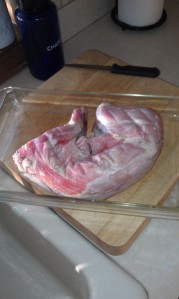
I sourced this delicacy from an old mountain man on the Grand Mesa. He breeds them, and I’m certain they live in peaceful coexistence and harmony right up until the end. At this point they meet either the point of a knife or the belly of a python (Yet another critter the old man propagates. I know, creepy right?). Unsure of what direction to pursue — French, Greek, or good old Southern Americana — I chose Julia and her arsenal for inspiration. After perusal of THE Julia Childs all-time cookbook, I decided on the French method.

I chopped carrots, celery and garlic while drinking a nice chilled glass of the soon-to-be released Mesa Park Riesling.

After refilling my wine glass (a very important step, mind you), I sautéed the veggies in 2 tablespoons or so of butter and chopped bacon. I finished by adding a healthy dose of dried, rosemary, sage, thyme and oregano from our herb garden. I stuffed the little guy as full as possible and off to the oven he went. 350 degrees for an hour or so. I monitored the internal temp for readiness.

Midway through cooking I glazed him in cherry sauce, which caramelized nicely by the end. A few swipes of the knife and he was ready for noshing! It paired extremely well with both the 2006 Cab Franc and the 2009 Family Reserve Red.

In the end, a mighty creature of the briar patch lived and died valiantly to become a succulent feast for the bellies of MPV.
Ciao,
Brad Webb

Bobby Rayburn is Duo's GM, and the friendly face behind the bar.
Psst. Here’s a little secret that might score you a free glass of wine next time you’re dining at the bar of Duo in the food-centric Highland neighborhood of Denver: Order the elk, and then answer “it’s from Colorado” to the question that follows.
General Manager Bobby Rayburn, who often tends the bar, has been known to pour the Mesa Park Vineyards 2006 Cabernet Franc for those who just ordered the elk, offering to buy it for them if they can guess its origin.
“They usually guess France, Provence or whatever,” he says. “I tell them Colorado, and they’re floored by it. It’s rich. That fact alone makes people think of France, and it’s good, it’s really good. That makes people assume France as well.”
He admits if too many people read this and go in armed with knowledge of his bar game, he might have to stop offering the giveaway bet. Probably not. Rayburn is big on interacting with those who sit at the bar (which is one of the most enjoyable ways to enjoy a brunch or dinner there). Considering Duo is big on local ingredients, slinging local brands is just something he likes to do, too.
“It gives me an opportunity to educate and inform them that there’s good wine in Colorado,” he says.
This coming from an admittedly beer-first kind of guy. “I drink beer just about every day. Beer is generally my go to,” he says. “I prefer wine with food. Quiet evening in with my girl is usually wine. Then it’s usually back to beer at the bar unless we’re at a good cocktail bar.”
Rayburn has been with Duo since it opened six years ago, jumping behind the bar from the get go, a part of a restaurant he’d never worked before. Well the switch from server to GM/bartender has been a welcome one.
“It’s the atmosphere. It’s the energy,” he says. “People sit at the bar, and they are out to have a good time. They are usually open minded and they are down to learn. I like to educate as much as possible and get people to try new things.”
Part of the reason Rayburn came to Duo — besides the chance to serve as general manager — was the concept.
Beyond being the the first stellar restaurant to open on the east side of the Highlands, an area that has become the epicenter for good food in Denver in the last few years, it focused on a local menu and being part of the neighborhood. It hasn’t strayed from there, producing a great seasonal American menu (serving perhaps the best brunch in Denver, too) that’s taken home numerous local and regional accolades along the way including being named one of the 25 best restaurants in Denver by 5280 magazine in 2011 (check out all the awards here).
Mesa Park and a few select other Colorado wines, several local spirits, and a 100 percent Colorado beer list play into the concept on the liquid side. The Mesa Park Cabernet Franc is a recent addition to the list (by the glass, $9, and bottle, $34).
It being the only Colorado wine by the glass allows for Rayburn’s guess-the-region game. But he also just loves it with the Elk Medallions ($26) on the menu right now, a dish that features a butternut squash puree and port reduction.
“The wine and that dish where meant to go together,” he says. “It’s got that crazy, crazy pepper on the nose and in the body. The pepper contrasts the sweetness of the butternut squash puree; how rich and deep the wine is makes it go really with the elk.”
More:
Get a glass of Mesa Park Cab Franc at Duo, 2413 W. 32nd Ave., Denver.
Wasn’t the temperature 80 degrees just the other day? This question rattles around my lobes each morning while I begrudgingly scrape the ice from my windshield. This morning on the way to school Liv asked, “Daddy, why is the grass white?”
“Because it’s so cold outside sweetie; don’t’ worry it won’t last long” I replied.

Vines in the snow
It’s amazing how quickly the vineyard morphs from a cornucopia of greened canopies to a barren, skeletal field. The change doesn’t happen overnight, it just seems so. Harvest comes, and we’re so inundated with crush, barrel conditioning and balancing various stages of fermentation, time seems to fly by while simultaneously standing still. The flow of patrons drastically falls off by early November, slowing to a trickle by Thanksgiving. Winter hours begin (11 a.m.–5 p.m. Saturdays and Sundays), and we take a collective deep breath. As the temps drop, I contemplate why more tasters don’t incorporate a wine country visit with Colorado’s greatest winter sport.
Doesn’t a nice glass of red wine (and Christmas snacks, of course) sound fantastic while snuggled near a rippling fire after a long day crunchy-grooving down the slopes? And instead of dragging your sore and unwilling butt back to the lift the next day, how about a nice day of wine tasting.
If skiing is your thing, the Grand Valley has access to plenty of world-class slopes. Located less than an hour from wine country is the fabulous Powderhorn Mountain Resort. Situated at the apex of the Grand Mesa, Powderhorn is a resort fit for all, with steep black diamonds, corduroy blues and easy-going greens. With fantastic ticket prices and virtually no lines to muddle your day, it has become the go-to resort for our family. The Wine Country Inn offers fantastic ski and stay packages, too.
If quaint resorts aren’t your thing, within two hours or so of the great Grand Valley you can cut tracks in Telluride, Aspen or another small but unique resort, Sunlight in Glenwood Springs. Hell, add another half hour and you can get to Crested Butte.
Maybe downhill isn’t your bag? The Grand Mesa is chock full of meandering cross-country ski trails to. Winding through beautiful forests while looking down on the serenity of the mesa toting a backpack stuffed with salami, cheese, olives and Mesa Park Reds sounds like a winning plan to me.

Skiing at Powderhorn (amazing views)
At the end of a Christmassy winter day, what goes better with achy, lactic filled muscles better than warmth, wine and food? Nothing. Maybe a nice Mesa Park Merlot, 2006 perhaps, combined with a glazed, spiral ham is what ails you. How about a nice Vienna Beef salami, baked to gooey perfection under a blanket of apricot preserves, served with our bold 2006 Cabernet Sauvignon? Better yet, pair your Christmas Goose with a Potato Gratin and our rich 2006 Cabernet Franc! Or you can have my favorite, a glass of Cab, a fireplace and a nice, stinky hunk of cheese. Buy Mesa Park Vineyards wine.
Still not enough enticement for you to visit wine country in the wintertime? How about some quality tasting time with the Price/Webb family? To say the least, our lives are dominated by wine. We relish any opportunity to share the lifestyle with patrons, we love to talk and talk and talk….about wine. Sometimes, we probably talk too much! With the reduced crowds and vineyard/winery workload in hibernation, we can spend plenty of time educating customers and answering questions. Plus, most Palisade area wineries offer winter hours, so there will be plenty of stops to make.
Did I forget to mention, it barely snows here (just at the ski resorts). I can’t think of a better time to escape the city than when a blizzard is bearing down. Would you rather have days of snow-packed streets and icy, clogged freeways or temps in the 40s, sunshine and wine? I thought so. The valley changes immensely with the winter solstice. What was once vibrant has dulled, the bountiful chirps and croaks quiet, leaves shrivel and blow in the wind. If you’ve never been here in winter, its time, isn’t it?
So, pack your bags, warm up the car and strap your skis to the roof. Point your car toward the Grand Valley and come spread some Christmas cheer on our slopes and drink Mesa Park Vineyard wines!
Hope everyone has a great holiday season.
— Brad Webb
Gnocchi oh gnocchi, where have you been? To be quite honest I’ve never met one of these potato rocks I liked. Way too dense and floury for me. That is until I stumbled along this recipe while slogging through another day of work. I’ve only made it once, but did receive nothing but good reviews. Here goes:
3-5 Large Russet Potatoes (starchy taters are necessary), scrubbed of dirt
1 egg yolk
2 or so cups of flour (depending on moisture content)
1/2 stick of butter, chilled and diced
1 tablespoon chopped sage (the fresher the better)
Kosher salt and pepper mill
1/4 cup (maybe more) Parmigiano-Reggiano
1. Cook potatoes at 350 Degrees until soft (about 1.5 hours). Don’t forget to prick the potatoes. 
2. Remove from oven and immediately cut the potatoes in half lengthwise. This maximizes surface area for evaporation. Water is the enemy.
3. Scoop the cooled potatoes from the skin and force through a ricer,. Spread into a 24 inch by 12 inch rectangle.
4. Season with salt and pepper; be generous because it’s a steaming pile of bland potato. When cooled, drizzle the beaten egg yolk and a cup of flour over the mixture.
5. With a pastry scraper fold the ingredients together until will mixed and the dough resembles course brad crumbs. gather mixture into a ball.
6. Sprinkle 1/4 cup of flour on your work surface (a cutting board perhaps) and flatten into a disc using both hands. Dump 3/4 cup flour onto the disc, incorporate. Continue to work until the dough isn’t sticky.
7. Roll into a log , dust with flour and let it chill for a few. Divide the log into 8 pieces; roll each into a 1/2 inch thick cylinder. Cut into 1 inch pieces.
8. Boil heavily salted water and drop in gnocchi. Work in a few batches, do not crowd the gnocchi, and remove them when they float. Brown the butter for 4 minutes and mix in the gnocchi, top with cheese. Voila!
Pair with 2006 Mesa Park Vineyards Estate Merlot.
More:
 People always want to pigeonhole Colorado wines into some other region in the world, and with our vineyard, it’s easy to say we produce juice just like Bordeaux.
We’re flattered. And it’s true. And it’s not true. Sorry to be ambiguous; stay with us for a second.
The first thing to understand is what it means when someone bestows the moniker of “Bordeaux style” on a wine or winery. Bordeaux is one of the most famed French growing regions in the world, and it’s treated like a trademark, meaning if a bottle says Bordeaux on it, it should actually be from Bordeaux, legally speaking.
This region is famous for making the best Cabernet Sauvignon and Merlot blends in the world. Other key grapes include Cabernet Franc and Petit Verdot (and to a lessor extent, Malbec and Carmenere). By definition, a Bordeaux red will always be a mix of these above grapes.
Since we only grow Cabernet Sauvignon, Merlot and Cabernet Franc on our 8 acres atop Orchard Mesa, it’s easy to understand why we might tell visitors our wines are Bordeaux in style. It’s simple to draw a comparison there, and we love to strive for a food-friendly blend like those French classics.
But Colorado is not France in more ways than just language and food. The Grand Valley where we grow our grapes has a warmer, shorter growing season. The soils are different, thus the wines are, too.
“Very few similarities,” says Horst Caspari, a professor of viticulture at Colorado State University’s Western Slope branch. “Your talking comparing different climates. You don’t get those temperatures for such an extended period of time. our growing seasons is shorter, it’s drier.”
Don’t look at that as a knock on Palisade. Wine should always give a sense of place. That’s why a Napa Cabernet is strikingly different from a Bordeaux. Life is no different here in terms of producing unique flavors.
“We make our own style, and Australian Shiraz is not a Rhone Syrah; that’s a good thing,” Caspari says. “Over time, people understand it’s different. Do you like Pepsi or Coke? Or do you drink Dr. Pepper?”
Our grapes tend to reach higher sugar contents than those from Bordeaux vines because of the high temperatures in the summer time, meaning we work with higher alcohol contents (15 percent is common). These produce bigger wines but we get nice earthy tones from the Orchard Mesa soil, too. Think of it as a nice mix of big, bold American Cabs from Napa and the more delicate, food-friendly wines of Bordeaux.
When the grape gods cooperate, we produce a Cabernet Franc, Cabernet Sauvignon, Merlot and blend of the three each vintage. Depending on the season, anyone of those can be the standout, but Cabernet Franc tends to be the most consistent.
“Well, that particular side has always done really well with Cabernet Franc,” Caspari says. “They have had pretty consistently had some of the best, if not the best, Cab Franc in Colorado.”
The reason for that being the average length of our growing season. Merlot ripens first, followed by Cabernet Franc, then Cabernet Sauvignon. So if it gets cold early in the fall, our Merlot will be the best of the bunch. If the heat lasts well into October, then Cabernet Sauvignon is the vintage winner. Most years, it’s somewhere in between, and our Cabernet Franc becomes the crowd pleaser.
Each year is different, just like our “Bordeaux” wines are a little different than the bottles that come from the famous region. So we suggest you stock up on our wines, get a few bottles from France and pick up some good Napa Cab and taste them all to see the differences first hand.
Feel free to invite us (or at least tell us about your experience).
Current Releases:
 November 18, 2011
 Brooke Of Wine
 Leave a comment
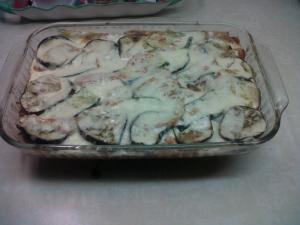
Here at Mesa Park Vineyards, one of our favorite things to do is prepare good food and enjoy it paired with wine and good friends. We love sharing our favorite recipes with you from time to time, and this Harvest Lasagna is one of our favorites.
Harvest Lasagna
Serves 6-8 people
Ingredients:
Directions:
Preheat oven 450 degrees oven racks: upper and lower thirds of oven. Layer eggplant in colander and sprinkle with salt. Let stand in sink for 20 minutes, then pat dry. Cook lasagna noodles, according to directions. Arrange zucchini on greased baking sheet, brush with olive oil, season with salt and pepper. Bake 15 minutes till tender. Transfer to plate, cool.
Arrange eggplant on baking sheet, brush with olive oil. Arrange tomatoes on second sheet, drizzle with olive oil, roast 25 minutes. Reduce oven to 400 degrees. Meanwhile, in a larger skillet over med. heat, cook the garlic in 1 tbsp olive oil, until golden. Add turkey and herbs and cook over medium heat, crumbling the meat, about 5 minutes. Stir in half marinara sauce. Grease a 9 by 13 baking dish, add remaining marinara sauce.
Add layer lasagna noodles, spoon turkey mixture on top; sprinkle 1/2 cup cheese. Add another layer of lasagna noodles, 1/2 cup alfredo sauce, the zucchini, 1/2 cup cheese and the tomatoes with their juice. Add final layer of lasagna noodles, 1/2 cup white sauce, then top with eggplant. Spread with the remaining 1 cup white sauce.
Cover dish with foil and bake 40 minutes. Uncover Sprinkle with remaining 1 1/2 cup cheese, bake until golden, about 10 minutes. Let cool 20 minutes. Enjoy!
Pair with 2009 Mesa Park Vineyards Estate Family Reserve Red.
More:

The Wine Country Inn in Palisade opened in 2007.
Most of us like to talk just about wine when discussing a trip to Palisade. But you need a place to sleep. Here are a few of our favorites for your next trip to a vino-soaked weekend along the Western Slope:
Palisade:
Wine Country Inn: Opened in 2007, this 80 room hotel was a huge addition to Palisade. It features all the amenities you need; employs a great staff; offers top nosh in its restaurant, Tapestry Lounge; features live music (seasonally); and has the best darn pool in the region. What else do you need? How about more wine? The Inn has its own house white and red, too. 777 Grande River Drive, (970) 464-5777

DiVine B&B in Palisade
DiVine Thyme B&B: Run by Tom and Cathy Monroe, this adorable B&B is housed in a Victorian and caters to those looking for a more intimate setting for their stay in Palisade. The vanilla poppyseed muffins are worth the drive to Palisade alone. 404 West 1st St., 970~464~9144
Vistas and Vineyards B&B: Run by Donna and Felix Iovanni, we often hear feedback about the espresso and the warm hospitality served up by these friendly folks. In the summer, they also host a summer concert series (among many others around town). 3587 G Road 970~464~7478
Nearby:
Springhill Suites by Marriott: If you want to explore Grand Junction as well as wine country, this hotel is within walking distance downtown, meaning it’s nearby some of our favorite places to eat such as Bin 707, Dolce Vita and Il Bistro. Grand Junction is a 15-minute drive from Palisade. 236 Main St., Grand Junction, (970) 424-5777
Island Acres in Fruita: For those with a little more of an adventurous spirit, this campground along the Colorado River is an incredible option during the warmer months. It’s minutes from Palisade — and even closer to world class mountain biking. You can bike year round!

 Mesa Park Vineyards' Blog